

Professional walkway construction does something few home upgrades can: it changes how your whole property reads from the street in a single weekend. Fresh paint, new shutters, and full flower beds all help, but if the path to your front door is cracked, tilted, or stained orange with Georgia clay, visitors notice that first.
Your walkway is the “connective tissue” of your home’s exterior. It links the driveway, the lawn, the porch, and the front door into one picture. When that link is clean and intentional, the house looks finished. When it is broken, everything around it looks a little more worn.
This guide takes a practical, design-first look at how a professionally built walkway lifts curb appeal. You’ll learn which concrete walkway designs fit your home’s style, how finishes compare on cost and upkeep, what the build should include, and how to decide between concrete walkway repair and full sidewalk replacement.
What “Curb Appeal” Really Means for a Walkway
Curb appeal is the impression a property makes from the street, usually in the first few seconds. A walkway affects that impression in three ways people feel even if they never name them.
It Creates an Entry Sequence
Good landscape design treats the trip from the street to the door as a short journey. A walkway sets the pace of that journey. A straight path says “efficient and formal.” A gentle curve says “relaxed and welcoming.” A landing at the base of the steps gives guests a place to pause before they knock. Professional walkway construction plans this sequence on purpose instead of pouring the shortest line between two points.
It Frames the Front Door
Your front door is the focal point of the house. A walkway that lines up with the door, or sweeps toward it, draws the eye straight there. A path that dead-ends at the driveway or hits the porch off-center pulls attention away and makes the entry feel hidden.
It Signals Care and Quality
People read hard surfaces as a sign of how a property is maintained. Level slabs, crisp edges, and straight joints say “well kept.” Heaved sections, patched cracks, and weeds in the joints say the opposite, even if the rest of the house is in great shape. For a home on the market, that perception matters. For a business, it shapes whether customers trust you before they walk in.
6 Ways Professional Walkway Construction Lifts Curb Appeal
Here’s what a skilled crew brings that a quick pour or a DIY weekend usually can’t.
1. Proportions That Fit the House
Width is the most common mistake we see. A narrow 24- or 30-inch path looks skimpy next to a two-story home. Most front walkways look and work best at 42 to 48 inches wide, which lets two people walk side by side. Secondary side paths can be 36 inches. A pro sizes the walkway to the scale of the house and the porch, not just the space available.
2. Lines That Look Intentional
Straight walkways need to be truly straight and square to the house. Curved walkways need smooth, wide arcs, not wobbly bends. Professionals use string lines, flexible forms, and layout paint to get those lines right before any concrete arrives.
3. A Surface That Stays Level for Years
Much of metro Atlanta sits on red clay that swells when wet and shrinks when dry. That movement is why so many walkways crack and tilt. Proper walkway construction removes soft soil, adds a compacted crushed-stone base, and reinforces the slab with wire mesh, rebar, or fibers. A level walkway keeps its clean look long after a cheap pour has started to heave.
4. Drainage You Never Have to Think About
A slight cross slope, typically around 1/4 inch per foot, sheds rain off the walkway and away from your foundation. That prevents puddles, the dark water stains that make concrete look dirty, and slick spots on cold mornings.
5. Clean Joints and Crisp Edges
Concrete always shrinks as it cures. Control joints placed at the right spacing make cracks form in straight, hidden lines instead of random zigzags. Tooled or saw-cut edges and smooth transitions to steps and the driveway are the finishing details that make the job look custom.
6. A Finish That Matches the Rest of the Property
The best walkways repeat something already on the property: the color of the brick, the texture of the patio, or the border on the driveway. That repetition makes the exterior feel planned as one design rather than added piece by piece.
Concrete Walkway Designs Matched to Your Home’s Style
Most design articles list finishes. We think it’s more helpful to start with your house. Here are concrete walkway designs that suit common home styles across Cobb County and metro Atlanta.
| Home Style | Walkway Shape | Finish Ideas | Finishing Touch |
| Traditional brick or colonial | Straight, centered on the door | Ashlar slate or running-bond brick stamp in warm red or charcoal | Smooth border, symmetrical path lights |
| Craftsman or bungalow | Straight with a wide landing | Broom finish with a darker integral-color band | Low plantings, square lantern lights |
| Ranch | Gentle curve from the driveway | Exposed aggregate or light broom finish | Wide planting beds on both sides |
| Modern farmhouse | Straight with crisp right angles | Smooth or light-broom gray with saw-cut grid | Black fixtures, gravel or grass strips |
| Cottage or Tudor | Meandering curve | Cobblestone or flagstone stamp in earthy tones | Stepping-stone side spurs, perennials |
| Commercial storefront or office | Straight, wide, ADA-friendly | Broom finish with contrasting border | Bright, even lighting, clear signage |
Finish Comparison: Cost, Traction, and Upkeep
Choosing a finish is a balance between budget, look, and how much care you want to give it. Here’s how the main options compare for residential walkways in 2026. Prices are typical installed ranges, not quotes.
| Finish | Typical Installed Cost | Slip Resistance | Upkeep | Curb Appeal Impact |
| Broom-finished concrete | About $6 to $12 per sq. ft. | High | Very low | Clean, simple |
| Colored or stained concrete | About $9 to $15 per sq. ft. | High | Reseal every 2 to 3 years | Medium |
| Exposed aggregate | About $10 to $16 per sq. ft. | Very high | Low, occasional sealing | Medium to high |
| Stamped concrete | About $12 to $20+ per sq. ft. | Moderate (add grit to sealer) | Reseal every 2 to 3 years | High |
| Scored or bordered concrete | About $8 to $14 per sq. ft. | High | Low | Medium to high |
Costs rise with curves, steps, steep grades, tight access, and old concrete removal. For a typical 4 by 30 foot front walkway, plain concrete often lands around $750 to $1,500, while stamped concrete may run $1,500 to $2,500 or more.
Small Add-Ons With a Big Visual Payoff
- Path lighting. Low-voltage LED lights spaced every 6 to 8 feet make the walkway a nighttime feature and improve safety.
- A landing at the steps. A wider pad at the base of the porch makes the entry feel generous and gives space for planters.
- Contrasting borders. A smooth or colored border frames a broom-finished path and makes it look custom for a modest cost.
- Planting pockets. Leaving soil strips along the edges softens the concrete and ties it into the landscape.
- Matching the driveway apron. Repeating the driveway’s border or color on the walkway unites the whole front yard.
What Professional Walkway Construction Includes
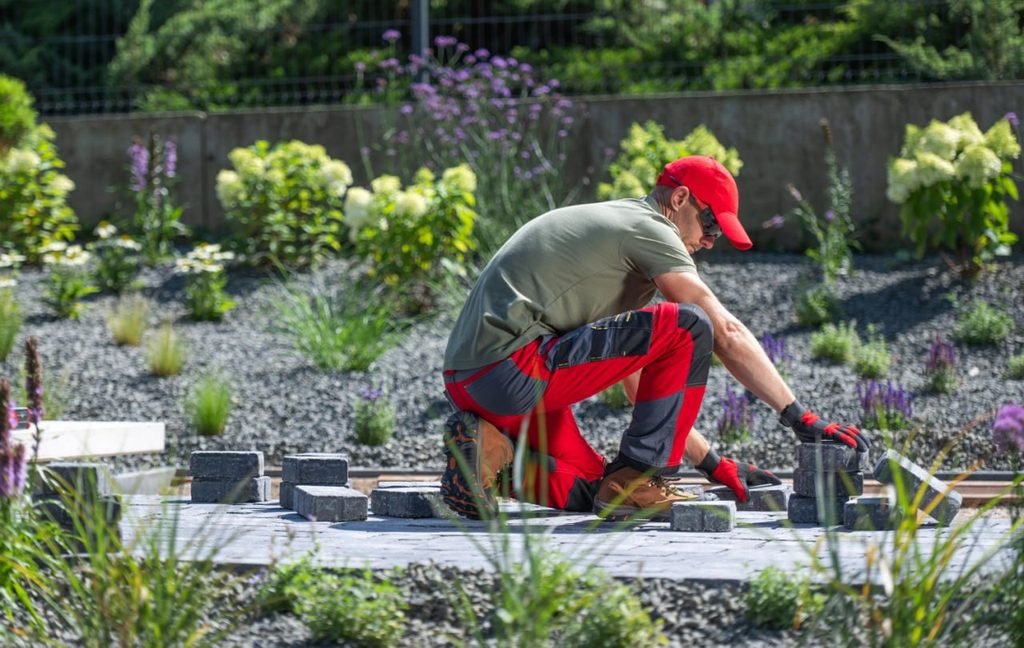
Knowing the steps helps you compare bids fairly and spot shortcuts. A professional job generally includes:
- Design and layout. Measuring, marking the path, and setting grade and slope. Georgia law requires a call to Georgia 811 before digging so underground utilities are marked.
- Excavation. Removing grass, roots, and soft or organic soil.
- Base preparation. Spreading and compacting crushed stone in layers. This step decides how long the walkway stays level.
- Forms and reinforcement. Setting forms for the shape and slope, then adding mesh, rebar, or fibers.
- Pour and finish. Placing, leveling, and finishing the concrete with a broom, stamp, or decorative texture.
- Joints and edges. Tooling or saw-cutting control joints and finishing the edges.
- Curing and sealing. Letting the slab gain strength and sealing decorative finishes.
Residential walkways are usually about 4 inches thick with a 3,000 to 4,000 psi mix. Most can be poured in a day or two, and you can typically walk on them after 24 to 48 hours. For a closer look at each stage of a new concrete sidewalk installation, read our step-by-step guide to Concrete Sidewalk Installation.
5 Questions to Ask Before You Hire
- How deep will the gravel base be, and will it be compacted?
- How thick will the slab be, and what reinforcement will you use?
- Where will control joints go, and how far apart?
- What slope will the walkway have, and which way will water drain?
- Is the work covered by a written warranty, and are you licensed and insured?
A low bid that skips these answers usually means a thinner slab or missing base. Those are the top reasons walkways crack and sink early.
Concrete Walkway Repair or Sidewalk Replacement?
If your existing walkway is hurting your curb appeal, you have two paths. The right choice depends on what’s happening under the surface.
| Problem You See | Likely Fix | Why |
| Hairline cracks that haven’t shifted | Concrete walkway repair (crack filling) | Slab is still sound |
| Faded color or worn sealer | Clean and reseal | Surface issue only |
| Light scaling, chips, or pitting | Resurfacing overlay | Restores the top layer |
| One section slightly sunken | Slab lifting and leveling | Base is mostly stable |
| Wide, growing, or offset cracks | Sidewalk replacement | Structural failure |
| Heaved slabs from tree roots | Sidewalk replacement and root management | Base has been disturbed |
| Water pooling or draining toward the house | Sidewalk replacement with new slope | Grade is wrong |
| Patchwork covering much of the path | Sidewalk replacement | Repairs no longer blend in |
Concrete walkway repair is a smart, budget-friendly way to refresh a slab that is still level and solid. Sidewalk replacement makes more sense when the damage is structural, when the walkway is a trip hazard, or when you want a new width, layout, or decorative finish. Replacement also lets the crew fix the real cause, such as a thin slab, no base, or bad drainage. Removal of old concrete usually adds about $2 to $6 per square foot.
Keep Your Walkway Looking Its Best
A professionally built walkway needs little care, but a few habits protect your investment:
- Reseal decorative and colored concrete every 2 to 3 years.
- Rinse off red clay, pollen, and leaves before they stain.
- Fill small cracks early so water can’t get in and widen them.
- Use sand or a concrete-safe ice melt instead of rock salt.
- Point downspouts and sprinklers away from the walkway.
- Trim roots and shrubs near the edges before they lift the slab.
Frequently Asked Questions About Walkway Construction
How much does walkway construction add to curb appeal compared to other upgrades?
A walkway is one of the few upgrades people physically use on the way in, so it shapes the first impression more than many cosmetic changes. Paired with lighting and fresh landscaping, it can make a front yard look fully updated. The resale effect depends on your market and the overall condition of the home.
What is the best concrete walkway design for a small front yard?
A gentle curve or a path with a wide landing at the door makes a small yard feel larger. Light colors and a contrasting border also help the path look wider and more defined.
Can a new walkway match my existing driveway?
Yes. A contractor can repeat the driveway’s color, border, or finish. Exact color matches on older concrete can be tricky, so a contrasting border is often used to tie the two together cleanly.
How long does concrete walkway repair last?
Crack filling and resealing typically last a few years before needing a touch-up. Resurfacing overlays and slab lifting can last much longer when the base underneath is stable.
How soon can I use my new walkway?
Most people can walk on new concrete after 24 to 48 hours. Wait about a week before rolling heavy loads over it, and allow about 28 days for full strength.
Do I need a permit for sidewalk replacement in Georgia?
Walkways on private property often don’t require a permit, but rules vary by city, county, and HOA. Work on a public sidewalk or in the right-of-way usually does. Your contractor can check the requirements for your address.
What time of year is best for walkway construction in Georgia?
Spring and fall are ideal because mild temperatures help concrete cure evenly. Summer pours are common too, with early start times and careful curing to manage the heat.
Make a Great First Impression With Big D’s Concrete
Your walkway is the first thing people walk on and one of the first things they notice. Professional walkway construction gives you a path that fits your home, drains properly, stays level, and looks sharp year after year. Whether you want a new stamped entry walkway, a clean concrete sidewalk installation, concrete walkway repair, or full sidewalk replacement, the right design and a solid build make all the difference.
Big D’s Concrete LLC builds walkways, sidewalks, patios, and driveways for homeowners and businesses in Mableton, Atlanta, Austell, Hiram, Dallas, and surrounding communities. Learn more about our Walkway Construction Service in Mableton, GA, or explore everything we offer as trusted Concrete Contractors in GA.
Leave a Reply