
Paver patios are one of the most popular ways to turn a plain backyard into a real outdoor room. Each paver is a separate unit set over a compacted base, so the finished surface can flex with the ground, drain well, and be repaired one piece at a time.
That flexibility is also why paver patios fail when the prep is rushed. Sunken corners, wobbly stones, and weeds in every joint almost always trace back to the base, not the pavers.
This guide covers the patio stones worth considering, backyard paver patio ideas for 2026, real costs, the full patio paver installation process, and an honest look at whether you should build your own patio or hire a pro.
What Are Paver Patios?
A paver patio is an outdoor surface made of individual units (concrete, brick, or natural stone) laid in a pattern over layers of gravel and sand. Instead of one solid slab, the pavers lock together through tight joints, edge restraints, and joint sand.
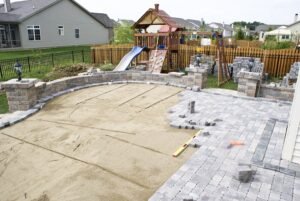
A properly built paver patio has four layers:
- Compacted subgrade: The native soil, graded and packed firm.
- Gravel base: Usually 4 to 6 inches of crushed stone for foot traffic, compacted in thin lifts.
- Bedding sand: About 1 inch of coarse sand, screeded flat.
- Pavers and joint sand: The surface you see, locked in with polymeric sand and edge restraints.
Because water can pass through the joints and the base, paver patios handle heavy rain and freeze-thaw cycles better than many solid surfaces.
Paver Patios vs Poured Concrete: Quick Comparison
Pavers are not the only option. Here is how they compare with a poured or stamped slab. For a deeper breakdown, see our Concrete Pavers vs Poured Concrete guide.
| Factor | Paver patio | Poured or stamped concrete |
| Upfront cost | Mid to high | Lower for plain designs |
| Repairs | Lift and replace single units | Patches can show |
| Cracking | Joints absorb movement | Control joints guide cracks |
| Weeds | Possible in joints without polymeric sand | No joints for weeds |
| Look | Modular patterns, mixed colors | Seamless, nearly any shape |
| Use right away | Yes, once joints are set | About a week of curing |
Bottom line: Pavers win on repairs and flexibility. Concrete wins on upfront cost and low upkeep. If you’re leaning toward a slab, browse our Concrete Patio Ideas for inspiration.
Choosing Patio Stones: Paver Materials Compared
The patio stones you choose set the look, budget, and maintenance of the whole project. Material prices below are for the pavers only, before installation, based on Lawn Love’s 2026 data.
| Material | Material cost per sq ft | Strengths | Watch out for |
| Interlocking concrete pavers | $3 to $6 | Strong, uniform, many colors and shapes | Color can fade without sealing |
| Concrete pavers (standard) | $4 to $6 | Affordable, easy to replace | Lower-end products may chip |
| Brick (clay) pavers | $4 to $8 | Classic look, color won’t fade | Fewer shapes, can grow moss in shade |
| Natural stone pavers | $7 to $16 | Premium, one-of-a-kind look | Uneven thickness, higher labor |
| Flagstone | $13 to $30 | Rustic, organic shapes | Hardest to install level |
Concrete Pavers
Concrete pavers are the workhorse of most paver patios. They’re made in molds, so sizes are consistent and installation is faster. Look for pavers that meet ASTM C936, the industry standard for strength and absorption.
Brick Pavers
Clay brick suits traditional and colonial homes. The color is baked through, so it won’t fade in the Georgia sun. Make sure you buy paving brick, not wall brick, which is too soft for foot traffic.
Natural Stone Patio Stones
Bluestone, travertine, slate, and flagstone bring a high-end, natural look. Each piece varies in thickness, so setting them level takes more time and skill, which raises labor costs.
Permeable Pavers
Permeable pavers have wider joints filled with small stone so rainwater drains straight through to the base. They’re a smart choice for yards with runoff problems, and some cities offer credits for reducing stormwater runoff.
Tip: Order 5 to 10 percent extra to cover cuts and breakage, and keep a few spare pavers from the same batch for future repairs. Colors can vary between production runs.
Backyard Paver Patio Ideas for 2026
Good design starts with how you plan to use the space. These backyard paver patio ideas are the ones homeowners ask about most this year.
1. Herringbone Pattern
A 45- or 90-degree herringbone is the strongest interlocking pattern and looks sharp with rectangular pavers. It’s a great pick for patios that connect to a driveway or walkway.
2. Large-Format Modern Slabs
Oversized 24 x 24 inch or 12 x 24 inch pavers in gray or charcoal create a clean, modern look with fewer joints to maintain.
3. Fire Pit Circle
A circular paver kit around a fire pit, wrapped by a low seat wall, is one of the most-used features in any backyard. It adds seating without adding furniture.
4. Contrasting Borders
A soldier-course or sailor-course border in a darker color frames the patio and hides small cutting lines at the edges.
5. Outdoor Kitchen and Dining Zone
Use one pattern for the grill and dining area and another for the lounge area. The change in pattern defines each zone without walls.
6. Multi-Level Patios for Sloped Yards
On a sloped lot, two levels joined by paver steps and a retaining wall turn a drainage problem into a design feature.
7. Paver Walkway Connections
Extend the same pavers into a path to the driveway, garden, or pool so the whole yard feels planned.
8. Mixed Materials
Combine a poured concrete field with paver borders, or pavers with natural stone steps. Mixing materials balances cost and style.
Design tip: Plan at least 25 to 30 square feet per person for a dining area, and leave 3 feet of walking space around furniture. A 12 x 16 foot patio comfortably fits a table for six.
How Much Do Paver Patios Cost in 2026?
According to Lawn Love (updated November 2026), paver patios cost about $3,350 on average for a 280-square-foot patio, with most homeowners paying between $2,275 and $6,950. That works out to roughly $8 to $24 per square foot installed.
Estimated installed cost by size:
- 10 x 10 ft (100 sq ft): about $800 to $2,400
- 12 x 16 ft (192 sq ft): about $1,550 to $4,600
- 20 x 20 ft (400 sq ft): about $3,200 to $9,600
What Raises or Lowers the Price?
- Paver material: Natural stone and flagstone cost far more than concrete pavers.
- Pattern: Herringbone, curves, and borders need more cuts and labor.
- Site prep: Removing an old slab, grading a slope, or hauling out clay adds cost.
- Access: Tight backyards may require hand-carrying base material.
- Extras: Seat walls, steps, fire pits, lighting, and sealing add to the total.
The only way to get a reliable number is an on-site estimate that measures your space and checks your soil.
Patio Paver Installation: Step by Step
Here is how professional patio paver installation works. These steps follow the general approach recommended by the Interlocking Concrete Pavement Institute (ICPI).
Step 1: Plan, Measure, and Call 811
Mark the patio outline with stakes, string, or marking paint. Before any digging, call 811 (Georgia 811) at least a few business days ahead to have underground utility lines marked. Check permits and HOA rules at the same time.
Step 2: Excavate
Dig out grass and soil to fit the base, sand, and paver thickness. For a standard patio, that’s usually about 7 to 9 inches deep: 4 to 6 inches of base, 1 inch of sand, plus the paver (often 2 3/8 inches). Extend the dig 6 to 12 inches past the patio edge so the base supports the edge restraints.
Step 3: Grade for Drainage
Shape the subgrade so the finished patio slopes away from your home at about 1/8 to 1/4 inch per foot. Then compact the soil with a plate compactor.
Step 4: Lay Geotextile Fabric
On clay or soft soils, a layer of geotextile fabric keeps the gravel base from mixing into the dirt over time. This step matters a lot in north Georgia’s red clay.
Step 5: Build and Compact the Base
Spread crushed stone (often called crusher run or GAB in Georgia) in 2 to 3 inch lifts, watering lightly and compacting each layer. A firm, well-compacted base is the single biggest factor in how long paver patios last.
Step 6: Screed the Bedding Sand
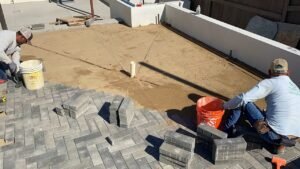
Lay screed rails (1-inch pipes work well), spread coarse concrete sand, and drag a straight board across the rails for a flat, even bed. Don’t walk on the screeded sand.
Step 7: Lay the Pavers
Start at a straight edge or corner, usually against the house, and work outward. Click each paver straight down into place rather than sliding it, and check your pattern lines often with string.
Step 8: Cut and Install Edge Restraints
Cut edge pavers with a wet saw or block splitter. Then secure plastic, aluminum, or concrete edge restraints with spikes to stop the patio from spreading.
Step 9: Compact and Fill the Joints
Run the plate compactor (with a protective pad) over the pavers to seat them. Sweep in polymeric sand, compact again, blow off the surface, and mist with water to activate the sand.
Step 10: Seal (Optional)
Wait for the joint sand to cure, then apply a breathable paver sealer to enhance color and resist stains. Plan to reseal every 3 to 5 years.
A typical professional crew finishes a medium-size patio in 2 to 5 days, depending on size, access, and weather.
Should You Build Your Own Patio?
Plenty of guides suggest you can build your own patio and cut the cost in half. The real numbers are less exciting. Lawn Love estimates DIY materials alone for a 280-square-foot paver patio at roughly $5,400 to $5,650, which is about what many homeowners pay a pro for the finished job.
DIY makes sense when:
- The patio is small (under about 150 sq ft) and on flat ground.
- You have help, a free weekend or two, and a strong back.
- You’re comfortable renting a plate compactor and wet saw.
Hiring a pro makes sense when:
- Your yard has a slope, poor drainage, or heavy clay.
- You want curves, borders, steps, or a fire pit.
- You’d rather not move 10 to 20 tons of gravel and sand by wheelbarrow.
- You want a written warranty on materials and labor.
Pros buy materials at contractor pricing, already own the equipment, and know how to fix base problems before they show up as sunken pavers.
Common Paver Patio Mistakes to Avoid
- Thin base: Skimping on gravel is the top cause of sinking and rutting.
- Too much sand: Bedding sand thicker than about 1 inch shifts and settles.
- No slope: Flat patios hold puddles and push water toward the foundation.
- Skipping edge restraints: Without them, pavers drift apart at the edges.
- Wrong joint sand: Regular play sand washes out and invites weeds and ants.
- Not calling 811: Hitting a gas or power line is dangerous and costly.
Paver Patio Tips for Georgia Homeowners
If you live in Dallas, Paulding County, or anywhere in metro Atlanta, plan for local conditions:
- Red clay: It swells when wet and shrinks when dry. Geotextile fabric and a deeper base help prevent heaving.
- Heavy summer storms: Good slope and, where needed, a drain line keep water off your patio.
- Sun and humidity: Sealing protects color and helps control mildew in shaded yards.
- HOA rules: Many subdivisions limit colors, size, and setbacks. Confirm before ordering pavers.
Planning a driveway too? Our team also works as Concrete Driveway Contractors Atlanta homeowners trust, so your driveway, walkway, and patio can match.
How to Choose a Paver Patio Contractor
When comparing contractors for patio paver installation, ask:
- How deep will you excavate, and how thick is the compacted base?
- Do you use geotextile fabric on clay soil?
- What edge restraint and joint sand will you use?
- Are you licensed and insured? Can I see local photos and references?
- Will I get a written estimate, timeline, and warranty?
- Who handles permits, HOA approvals, and calling 811?
A good contractor answers these clearly and puts it in writing.
Frequently Asked Questions About Paver Patios
How long do paver patios last?
With a well-built base and basic upkeep, paver patios can last 25 to 50 years or more. Individual pavers can be replaced if one cracks or stains.
How deep should a paver patio base be?
For foot traffic, most patios use 4 to 6 inches of compacted gravel plus about 1 inch of bedding sand. Clay or poorly draining soil may need more.
Is it cheaper to build your own patio?
Not always. DIY saves labor, but materials, tool rentals, and delivery can bring the total close to a professional price, especially for larger patios.
Are pavers better than concrete for a patio?
Pavers are easier to repair and handle ground movement well. Poured concrete usually costs less upfront and has no joints to maintain. The best choice depends on your budget and style.
Do paver patios need to be sealed?
Sealing is optional but recommended. It protects color, resists stains, and helps lock joint sand in place. Most sealers last 3 to 5 years.
Can pavers be installed over an existing concrete patio?
Sometimes. If the slab is level, crack-free, and drains well, thin pavers can be set over it. Cracked or sinking slabs should be removed first.
Ready to Build Your Paver Patio?
Great paver patios come down to smart design, quality patio stones, and a base built for Georgia soil. Whether you want a simple square for a grill and table or a multi-level outdoor living space with a fire pit, getting the details right up front saves money for years.
At Big D’s Concrete LLC, we design and build paver patios, concrete patios, walkways, and driveways for homeowners across Dallas, GA and metro Atlanta. Learn more about our Concrete Contractors in Dallas, GA team.
Call Big D’s Concrete LLC today for your free paver patio estimate, and let’s build the backyard you’ve been picturing.
Leave a Reply