
Custom patio construction turns an ordinary backyard into a space you actually use: a place for morning coffee, weekend cookouts, and evenings around the fire pit. Unlike a basic slab, a custom patio is planned around your yard, your home’s style, and the way your family lives.
But a great patio is more than a pretty surface. Cost, materials, soil, drainage, and the crew you hire all decide whether it still looks good in 20 years or starts cracking after two winters.
This guide covers the custom patio designs homeowners love in 2026, real price ranges (including paver patio cost), the patio construction tools pros rely on, a step-by-step look at the build, and how to choose the right backyard patio contractors.
What Is Custom Patio Construction?
Custom patio construction is the process of designing and building an outdoor hardscape that is made for one specific property. Instead of pouring a standard rectangle off the back door, the patio is shaped, sized, and finished to fit:
- The layout and slope of your yard
- How you plan to use the space (dining, lounging, grilling, entertaining)
- Your home’s architecture and color palette
- Local soil, rainfall, and building rules
A custom project might include curves, multiple levels, built-in seat walls, a fire pit pad, steps, decorative borders, or an outdoor kitchen base, all planned before the first shovel hits the ground.
Custom Patio Designs: 8 Ideas for 2026
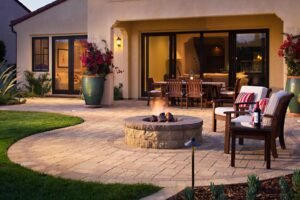
Good design starts with how you want to feel in the space. Here are the custom patio designs homeowners are asking for most this year. For a deeper look at styles and colors, see our guide to Concrete Patios Design trends for 2026.
1. Outdoor Living Zones
Break one large area into a dining zone, a lounge zone, and a grill station. A change in pattern or border color defines each zone without adding walls.
2. Stamped Stone and Slate Looks
Stamped concrete can copy slate, flagstone, or cobblestone at a lower price than natural stone, with no loose pieces to trip over.
3. Wood-Plank Concrete
Wood-grain stamps give you the warm look of a deck without rot, termites, or yearly staining. It is a smart pick for pool surrounds and fire pit areas.
4. Curved and Free-Form Shapes
Gentle curves that follow garden beds or the tree line feel relaxed and custom. They also soften the hard lines of a home’s foundation.
5. Multi-Level Patios for Sloped Yards
On a sloped lot, two or three levels connected by steps turn a drainage problem into a design feature. Retaining walls can double as extra seating.
6. Fire Pit and Seat Wall Combos
A round fire pit pad wrapped by a low seat wall is one of the most-used patio features. It adds seating without adding furniture.
7. Covered Patios with Smooth Finishes
Under a pergola or roof extension, a smooth or lightly broomed finish with a clear sealer creates a clean, modern look that flows from the living room.
8. Mixed Materials
Combine a poured concrete field with paver borders, or stamped concrete with natural stone steps. Mixing materials adds contrast and lets you balance cost with style.
Design tip: Plan at least 25 to 30 square feet per person for a dining area, and leave 3 feet of walking space around furniture. A patio that feels cramped rarely gets used.
How Much Does Custom Patio Construction Cost in 2026?
According to Lawn Love’s 2026 cost data, the national average for a new patio is about $4,500, with most homeowners paying between $2,290 and $6,420. Your price depends mostly on the material, size, design detail, and how much site prep your yard needs.
Patio Cost per Square Foot by Material
| Material | Typical installed cost per sq ft | Best for |
| Plain poured concrete | $4 to $10 | Budget-friendly, simple layouts |
| Stamped concrete | $8 to $25 | Stone, slate, or wood looks with low upkeep |
| Pavers | $8 to $25 | Easy spot repairs, modular patterns |
| Brick | $9 to $21 | Classic and traditional homes |
| Flagstone | $8 to $35 | Natural, rustic designs |
| Gravel | $2 to $7 | Casual seating areas, low budgets |
National ranges from Lawn Love (updated October 2026). Local prices vary.
Paver Patio Cost by Size
Paver patio cost averages about $3,350 for a 280-square-foot patio, or roughly $8 to $24 per square foot installed, per Lawn Love. Here is what that looks like by size:
- 10 x 10 ft (100 sq ft): about $800 to $2,400
- 12 x 12 ft (144 sq ft): about $1,150 to $3,450
- 20 x 20 ft (400 sq ft): about $3,200 to $9,600
What Raises or Lowers the Price?
- Site prep: Grading, removing an old slab, or hauling out soil adds labor and disposal fees.
- Design detail: Multiple colors, borders, and complex stamp patterns cost more than a single-color finish.
- Built-in features: Steps, seat walls, fire pits, and outdoor kitchen bases add to the total, but cost far less when poured with the main slab.
- Access: If a concrete truck or skid steer can’t reach the backyard, extra labor or pumping may be needed.
- Drainage: Yards that hold water may need French drains or extra base material.
The only way to get an accurate number is an on-site estimate from a local contractor who measures your space and checks your soil.
Paver Patio vs Concrete Patio: Which Should You Choose?
Both are excellent choices for custom patio construction. The right one depends on your budget, style, and how much maintenance you want.
| Factor | Poured or stamped concrete | Pavers |
| Upfront cost | Lower for plain and mid-range designs | Usually mid to high |
| Surface | One continuous slab | Individual units on sand and gravel |
| Weeds and ants | No joints for weeds to grow through | Joints can sprout weeds |
| Repairs | Harder to patch invisibly | Easy to lift and replace one unit |
| Maintenance | Reseal every 2 to 5 years | Re-sand joints and reseal |
| Design freedom | Nearly unlimited shapes, colors, and patterns | Limited to available paver styles |
Bottom line: Concrete wins on design freedom and low upkeep. Pavers win on easy spot repairs. Many homeowners use both, with a concrete field and paver borders.
Patio Construction Tools the Pros Use
Professional results depend on the right equipment. These are the core patio construction tools used on most jobs:
Site prep and excavation
- Mini excavator or skid steer: Digs out soil and moves base material quickly.
- Transit or laser level: Sets the exact grade so water drains away from the house.
- String lines and stakes: Mark the patio’s layout and finished height.
Base and compaction
- Plate compactor: Packs the gravel base in thin layers so the patio won’t settle.
- Wheelbarrows and rakes: Spread base material evenly.
Concrete work
- Forms and stakes: Hold the shape of the pour, including curves.
- Screed board and bull float: Level and smooth fresh concrete.
- Edgers and groovers: Round the edges and cut control joints.
- Stamp mats and release agent: Create stone, slate, or wood textures.
Paver work
- Wet saw or block splitter: Cuts pavers cleanly around curves and edges.
- Rubber mallet and screed rails: Set and level each paver.
Renting these tools for a DIY job can add up fast, and the learning curve is steep. Most homeowners find that hiring a crew that already owns the equipment saves money and avoids costly mistakes.
Step-by-Step: How a Custom Patio Is Built
Step 1: Design and Planning
Your contractor measures the yard, discusses how you’ll use the space, and sketches the layout, material, and features. This is also when permits and HOA approval are checked.
Step 2: Layout and Excavation
The patio outline is marked with stakes and string. Crews dig out grass and soil, usually 4 to 8 inches deep depending on the material and base needed.
Step 3: Grading for Drainage
The subgrade is shaped so the finished patio slopes away from your home, typically about 1/8 to 1/4 inch per foot. This keeps water away from your foundation.
Step 4: Building the Base
A layer of crushed gravel is spread and compacted in lifts with a plate compactor. A strong, compacted base is the single biggest factor in how long your patio lasts.
Step 5: Forms and Reinforcement (Concrete)
For poured concrete, forms are set to hold the shape, and rebar or wire mesh is added to help control cracking.
Step 6: Pouring or Laying the Surface
Concrete is poured, leveled, finished, and stamped or colored. For pavers, a sand bedding layer is screeded and each paver is set in pattern.
Step 7: Joints, Curing, and Sealing
Control joints are cut in concrete to guide natural cracking. Pavers get polymeric sand in the joints. Once cured, the surface is sealed to protect color and resist stains.
Most custom patios take a few days to two weeks from excavation to finish, depending on size, weather, and features. Concrete usually needs about a week before it is ready for furniture and normal use.
Building Tips for Georgia Homeowners
Local conditions matter. If you live in Mableton or anywhere in metro Atlanta, keep these tips in mind:
- Prepare for red clay. Georgia clay holds water when wet and shrinks when dry. A properly excavated and compacted gravel base helps prevent heaving and cracking.
- Plan for heavy rain. Summer storms dump water fast. Good slope and, when needed, a drain line keep puddles off your patio and away from your foundation.
- Seal against sun and humidity. Resealing every 2 to 5 years protects color and prevents mildew in shaded areas.
- Add slip resistance near pools. Ask for a light broom finish or a non-slip additive in the sealer.
- Check permits and HOA rules. Many Cobb County neighborhoods have rules on size, setbacks, and colors. Confirm before work begins.
Want to see local projects? Explore our Concrete Patios in Mableton, GA page.
Common Patio Building Mistakes to Avoid
- Skipping base prep. Thin or poorly compacted bases are the top cause of sinking and cracks.
- Ignoring drainage. A flat patio or one that slopes toward the house invites water damage.
- Building too small. Lay out your furniture first. Most families wish they had gone bigger.
- Forgetting control joints. Without them, concrete cracks randomly.
- Adding features later. Steps, seat walls, and fire pits cost far more as add-ons.
- Hiring on price alone. The lowest bid often means a thinner slab or less base.
How to Choose Backyard Patio Contractors
The right crew makes all the difference. When comparing backyard patio contractors, ask:
- How many custom patios have you built in my area? Can I see photos and references?
- Are you licensed and insured?
- How deep will you excavate, and how thick will the base and slab be?
- What reinforcement, joint spacing, and sealer do you use?
- Will I get a written estimate, timeline, and warranty?
- Who handles permits and HOA approvals?
A trusted contractor will answer every question clearly and put the details in writing. Working with experienced Concrete Contractors means your patio is built for local soil and weather from day one.
Frequently Asked Questions About Custom Patio Construction
How much does custom patio construction cost?
Most homeowners pay between about $2,290 and $6,420, with a national average near $4,500. Large patios with stamped finishes, multiple levels, or built-in features can cost more.
Is a paver patio cheaper than concrete?
Plain poured concrete is usually cheaper than pavers. Stamped concrete and pavers often fall in a similar range of about $8 to $25 per square foot, depending on design.
How long does it take to build a custom patio?
Most projects take a few days to two weeks. Concrete needs about a week to cure before heavy furniture and regular use.
Do I need a permit for a patio?
It depends on your city, county, and HOA. Ground-level patios often don’t need a permit, but raised patios, covered patios, and work near property lines may. Your contractor should confirm local rules.
Does a new patio add value to my home?
A well-built patio adds usable living space and curb appeal, which can make your home more attractive to buyers. The return depends on your local market and the quality of the work.
How long does a concrete patio last?
With a solid base, proper reinforcement, and regular sealing, a concrete patio can last 25 years or more.
Ready to Start Your Custom Patio Construction?
The best patios combine smart design, honest pricing, and a base built to last. Whether you want a simple poured slab, a stamped stone look, or a multi-level outdoor living space, planning the details first saves money and headaches.
At Big D’s Concrete LLC we design and build custom patios for homeowners across Mableton and Cobb County, GA. From layout and excavation to the final seal, our team handles every step with care.
Leave a Reply